Pack ID
- 0.0
- Rating
- 10.00K
- Installs
- Free
- Price

 Analysis by App-foxy
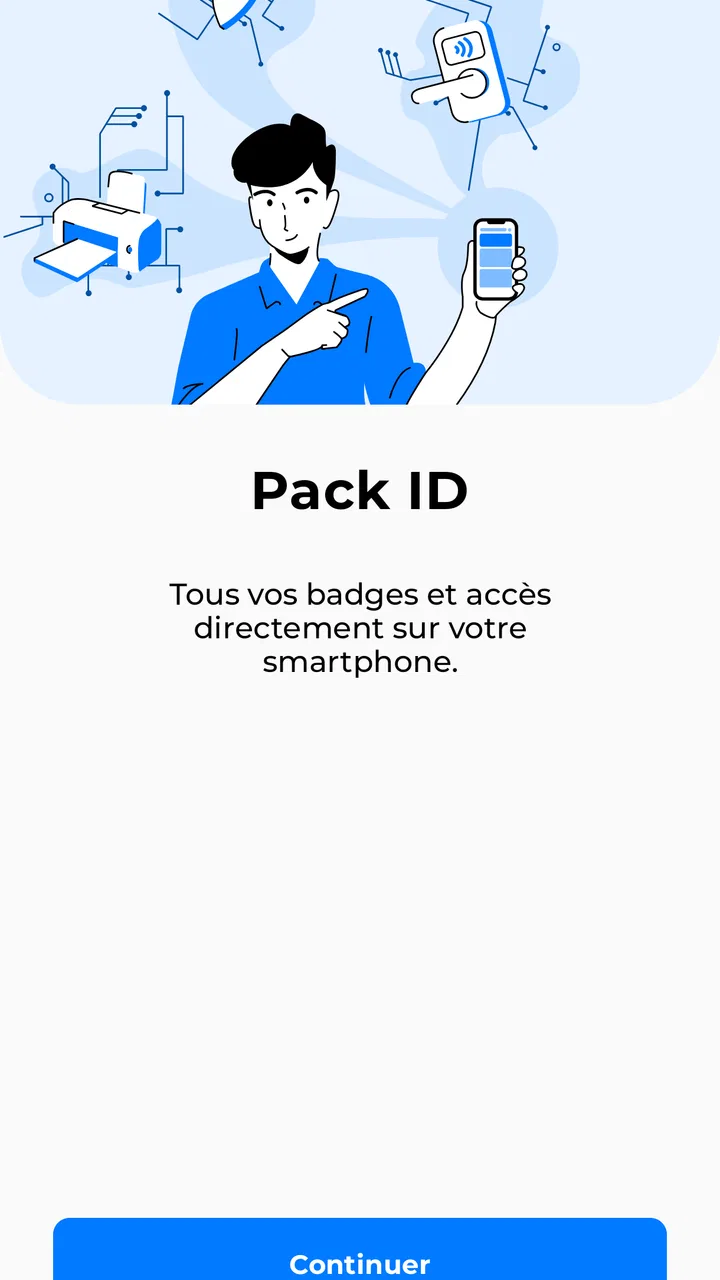
Pack ID is a specialized mobile app from OBS SA, built for Orange’s badge digitization solution. That description tells me more about its audience than its interface: this is not a general-purpose library tool, a consumer badge wallet, or a demo app meant to entertain everyone. It is a focused utility for people who need to work with Orange’s badge digitization process on a compatible device.
My first impression is that its appeal depends almost entirely on whether I am already part of the workflow it supports. If I am, the narrow purpose can be useful because I do not have to search through a broad collection of unrelated tools. If I am not, there is very little reason to keep it installed. Pack ID makes sense as a work companion, not as a casual download.
What the first week feels like
During the first week, the main question is not whether the app offers a large range of options. It is whether it fits neatly into the badge digitization routine I already follow. The store summary identifies it as a mobile application for Orange’s solution, while the short description calls it “Pack ID.” That combination suggests a practical role: the app is there to support an existing identification or packaging step rather than teach me a complete process from scratch.
You May Also Like

 AccuWeather: Weather Radar
AccuWeather Review: A Quick, Clear Forecast for Everyday Decisions
For everyday plans, the best forecast is the one you can understand quickly. AccuWeather makes rain timing, radar, and local conditions easy to act on, with a few trade-offs.

 Hill Climb Racing
Why Hill Climb Racing Still Turns Crashes Into One More Run
A tiny car, a bumpy hill and one more upgrade: Hill Climb Racing keeps resurfacing because its simple chaos makes every near-miss feel personal.

 AliExpress - Shopping App
AliExpress Makes Global Shopping Feel Personal, but Shoppers Bear the Risk
AliExpress turns a global marketplace into a pocket-sized discovery engine. Its reach is useful, its shopping loop compelling, and its trade-offs easy to miss.

 Lords Mobile: Kingdom Wars
Lords Mobile Is a Kingdom-Building Routine, Not a Quick Match
A case-by-case verdict on the building, battles, device demands, and social commitments that make Lords Mobile rewarding for some players and exhausting for others.

 PDF Scanner app - TapScanner
TapScanner Makes Paperwork Easier to Capture, Check, and Share
TapScanner makes scanning with a phone feel less like a rescue operation and more like a dependable step in getting work done. Its capture tools are useful, though not flawless.

 Block Blast!
 Shows How Much a Puzzle Game Can Leave Out
A quiet grid game shows why puzzle players increasingly value instant clarity, repeatable skill and low-pressure play—and where the genre still needs to catch up.
More From Our News Desk
View All News


That narrow role can be a strength. A dedicated app is often easier to understand than a general scanner, notes app, or improvised camera workflow when the task involves a specific organizational system. Instead of turning a phone into a collection of loosely connected tools, Pack ID gives the supported process its own place. For a worker who receives clear instructions from an employer or Orange-related setup, that focus may make the first interaction feel more direct.
It is also where the first limitation becomes obvious. I would not install this expecting a self-contained badge-management experience with broad personal features. The app’s value is tied to the surrounding solution. If I am evaluating it for a team, I would first confirm that the organization actually uses Orange’s badge digitization system and that Pack ID is part of the intended mobile workflow. Without that connection, installation alone is unlikely to create a useful result.
The app belongs to the Libraries & Demo section, but that label should not lead me to expect a conventional digital library. In this case, the category is better understood as a store classification than as a promise of books, media collections, or browsing tools. That distinction matters because someone searching for a personal archive, document organizer, or badge collection app could easily misunderstand its purpose.
Pack ID is free to install, which lowers the barrier for a quick trial. I can test whether it belongs in my organization’s process without making a purchase decision first. The content rating is Everyone, so the store presentation does not position it as an age-restricted product. Still, an unrestricted age label does not make it universally useful; the practical requirement is compatibility with the Orange workflow.
A realistic first-use scenario
Imagine a staff member arriving at a site where badges need to be digitized as part of an established Orange process. The phone is used as one step in that routine, and the employee needs a dedicated utility rather than a general camera app. In that situation, Pack ID can earn its place quickly: it is already associated with the job, the task is repeated, and the app’s narrow purpose reduces the temptation to improvise.
The same scenario also shows why setup and instructions matter. If the employee does not know what the app is supposed to recognize, where the resulting information goes, or what to do after the mobile step, the app cannot compensate for a missing procedure. I would treat it as one component in a wider operational chain. Before rolling it out, a supervisor should give users a short sequence covering when to open it, what to scan or identify, how to check that the step worked, and what happens next.
That is one of the less obvious lessons with Pack ID: the quality of the surrounding workflow may matter more than the app’s novelty. A focused utility can be reliable in a well-defined process and confusing in an undocumented one. For a personal user, that makes it less flexible than a general scanning application. For a business user, it can make it easier to standardize a repeated task.
Who benefits from the focused design
I see the strongest fit for employees, contractors, or teams that have been asked to use Orange’s badge digitization solution. The app may also be appropriate for a test device used by an administrator who wants to validate the mobile part of that process before wider deployment. In both cases, the user has a clear reason to open it repeatedly.
I would skip it if I simply want to store membership cards, digitize personal documents, photograph identification, or maintain a private badge collection. A normal scanner, camera, wallet, or document-management app would be easier to justify because those tools are designed around broader personal needs. Pack ID’s specialization is not a defect, but it means the wrong audience will experience it as unnecessary rather than helpful.
Whether it earns a place after the novelty fades
I judge Pack ID’s staying power by whether it remains a clear, dependable step in the badge routine, not by how often I open it for its own sake. A team can make that easier by reviewing its instructions whenever roles or phone setups change, so people know when the app belongs in the process and where to turn if they get stuck.
Month-to-month value comes from repetition
After the initial trial, the app’s lasting value depends on frequency. If badge digitization is part of a daily or weekly responsibility, Pack ID can become a small but dependable part of the routine. It does not need to be exciting to be useful. In a work setting, an app that opens for one predictable job and stays out of the way can be more valuable than a feature-heavy alternative that requires extra decisions.
If I only need the task once every few months, the calculation changes. A specialized app can be easy to forget between uses, especially when its purpose is not relevant to anything else on the phone. I would then keep a written reminder of the workflow and confirm that the app is still supported on the device before the next important use. That is not a criticism unique to Pack ID; it is the natural trade-off of a narrow utility.
The current version is 3.0.9, and the app was released on June 27, 2017. Those details give the product a longer history than a newly launched tool, but they do not by themselves guarantee that it will remain central to a modern workplace. For me, the practical test is whether it continues to serve the organization’s current badge process without creating extra steps. A mature app can be reassuring when it remains stable, yet stability only matters if the underlying service is still part of the user’s routine.
The public store footprint is modest, with over 10K installs and an average rating of 0.0. I would not read that rating as a meaningful judgement about everyday performance because a zero average does not provide the kind of user feedback I normally use to compare apps. Instead, I would judge Pack ID through a controlled workplace trial: test the supported badge flow with several users, repeat it under ordinary conditions, and see whether people can complete the task without repeated assistance.
That trial should focus on recurring value rather than first-day curiosity. Can a new employee understand when to use it? Can an experienced user complete the task quickly? Does the team know what a successful result looks like? Can the workflow be recovered if a phone is replaced? These questions reveal more about long-term usefulness than the existence of a dedicated icon on the home screen.
The maintenance burden is mostly organizational
Pack ID appears simple to maintain from a user’s perspective because its role is narrow. I would not expect to manage a large personal database, curate content, or spend time customizing a dashboard. The bigger burden is operational: keeping the app available on the right devices, ensuring users know its purpose, and checking that it still matches the organization’s badge digitization instructions.
That distinction is important for managers. A small app can still create support work if employees confuse it with a general identification tool or install it without the required account, device configuration, or process guidance. I would include Pack ID in onboarding materials rather than assuming that its name explains everything. A short internal note should identify the exact moment when the app is used and the person responsible for resolving failures.
For an individual, maintenance may simply mean leaving it installed and remembering why it is there. I would avoid clearing its data or removing it casually if the organization has not explained how the app participates in the workflow. At the same time, I would not keep it permanently on a personal phone just because it is free. If I no longer use the Orange solution, uninstalling it is reasonable housekeeping.
Device compatibility also deserves attention. The listed minimum operating system is Android 8.0, so a supported Android phone must meet that baseline. That makes the app accessible to a range of older devices, but an operating-system requirement is only the starting point. In a real deployment, I would test the exact phone models used by the team, especially if the badge process is time-sensitive or performed in locations where replacing a device is inconvenient.
Where fatigue can appear over time
The main source of fatigue is repetition without visible context. If I open Pack ID only to perform a small step and then move to another system, the app may feel like an extra stop in the process. That feeling grows when instructions are unclear, when users must remember separate credentials or procedures, or when the result of the mobile action is not obvious.
Another source of fatigue is the gap between a specialized app and general phone habits. People are used to solving quick identification tasks with the camera, a wallet, or a messaging app. Pack ID asks them to remember that this particular task belongs in a dedicated Orange-related utility. The more occasional the task, the more likely users are to question why a separate app is necessary.
There is also a team-level risk: inconsistent use. If some employees use Pack ID while others take screenshots, photographs, or handwritten notes, the organization may lose the benefit of a standardized process. I would address that by defining one approved route and explaining the reason for it. The app should not be presented as a novelty; it should be presented as the expected step for a particular job.
On the other hand, the focused scope can reduce fatigue when the process is stable. I do not have to turn a general-purpose tool into a badge utility through manual naming, folder organization, or repeated configuration. That is the trade-off I would keep in mind: Pack ID is less adaptable than a broad app, but its specialization may reduce clutter for the people who genuinely need it.
How it compares with usual alternatives
The most obvious alternatives are a phone camera, a document scanner, a digital wallet, or a general identity-management platform. Those options may be better for personal use because they support more kinds of content and are familiar outside one workplace. They are also easier to repurpose when a user changes jobs or no longer handles badges.
Pack ID has a different advantage. A general camera can capture an image, but it does not automatically become part of Orange’s badge digitization workflow. A wallet can hold cards, but that does not make it an operational tool for a defined organizational process. A broad platform may offer more capabilities, but it can also require more configuration and training. I would choose Pack ID when alignment with Orange’s solution matters more than flexibility.
For a small team, the decision should be based on process ownership rather than app count. If the organization already relies on Orange’s system, using its dedicated mobile component is likely more coherent than asking staff to invent a parallel method. If the organization only wants occasional badge photographs or a simple personal archive, a general tool will probably be the better choice.
Questions I would settle before relying on it
Before making Pack ID part of a serious routine, I would ask who provides the workflow instructions and what a successful mobile result looks like. I would also confirm whether the app is intended for every employee or only for specific roles. Those answers prevent a common mistake: treating a specialized component as if it were a complete standalone service.
I would then test the process on the phones people actually carry. The minimum Android requirement is useful when screening devices, but hands-on testing reveals whether the app fits the team’s hardware, working environment, and timing. I would include a new user in the trial, not only an administrator, because a process that works for its designer may still be difficult for someone seeing it for the first time.
Finally, I would decide what happens when the app is unavailable or a user changes phones. A good operational plan should identify a temporary fallback and a support contact. That does not mean Pack ID is unreliable; it means any recurring workplace app deserves a recovery plan. The more important the badge task, the less sensible it is to rely on memory alone.
My long-term verdict
Pack ID earns lasting space only when Orange’s badge digitization solution is already part of my work. In that setting, its narrow purpose is a sensible reason to keep it installed, and the free price makes evaluation straightforward. I would recommend it to the intended users, particularly teams that value a consistent mobile step over the flexibility of a general-purpose alternative.
I would not recommend it as a discovery download for ordinary phone owners. The Everyone rating and modest installation footprint do not change the central issue: this is a specialized app whose value comes from context. If I do not have a badge workflow that calls for it, the app is unlikely to develop recurring personal value after the first look.
My final judgement is therefore practical rather than enthusiastic. Pack ID is not the kind of app I would keep for entertainment or broad everyday organization. It can, however, be the right small tool in a defined Orange process. Its long-term success depends less on novelty than on habit, clear instructions, and a real recurring need. For the audience it serves, that may be enough; for everyone else, a broader and more familiar alternative will make better use of the phone’s storage.
FAQs for Pack ID
01What is Pack ID and what does it offer?
Pack ID is a comprehensive app designed to streamline the process of tracking and managing your shipments. It provides real-time updates on package locations, estimated delivery times, and notifications for any status changes. The app supports multiple courier services, making it a versatile tool for both personal and business use.
02Is Pack ID available on both Android and iOS platforms?
Yes, Pack ID is available for both Android and iOS devices. You can download it from the Google Play Store for Android devices and the Apple App Store for iOS devices. The app is optimized for a seamless experience on both platforms, ensuring you can track your packages on the go.
03Does Pack ID support notifications for delivery updates?
Absolutely, Pack ID offers push notifications to keep you informed about the status of your shipments. You’ll receive alerts for key events such as package dispatch, out-for-delivery status, and successful delivery. This feature ensures you never miss an important update regarding your shipments.
04Are there any subscription fees or in-app purchases in Pack ID?
Pack ID is free to download and use; however, it may offer premium features or ad-free experiences through in-app purchases. These optional upgrades can enhance your experience by providing additional functionalities such as advanced tracking options or integration with more courier services.
05How user-friendly is the Pack ID app for beginners?
Pack ID is designed with a user-friendly interface that caters to all users, including beginners. The setup process is straightforward, and tracking a package is as simple as entering a tracking number. The app’s intuitive design ensures that even users with minimal technical knowledge can navigate it with ease.
Pros
- Intuitive user interface design.
- Fast and accurate package tracking.
- Supports multiple carriers worldwide.
- Customizable notifications for updates.
- Offline mode for tracking history.
Cons
- Limited free features; premium needed.
- Ads can be intrusive at times.
- Occasional syncing delays.
- No dark mode available.
- Doesn't support all small carriers.

Pack ID
Gallery